Facilities Planning Process: A Summary of Stakeholder Feedback
Summary of Community Engagement Sessions across Schools Recommended for Closure: February 2026
From February 2 – February 22, 2026, the District hosted 43 Community Engagement Feedback Sessions about the District’s proposed facilities plan. Brownstone PR, a consulting firm contracted by SDP, facilitated the community engagement sessions and took notes summarizing participant responses.
Staff in the Office of Evaluation, Research, and Accountability organized the responses both by overall theme and by school. Click the image below to view the results.
FPP Emerging Themes Survey Results: December 2025
From November 18 – December 11, 2025, the FPP Emerging Themes Survey was open for the public to submit feedback on four key themes guiding the next phase of planning:
- Strengthening PreK–8 Programming Through Better Use of Space
- Reducing Unnecessary School Transitions for Students
- Reinvesting in Neighborhood High Schools as Community Anchors
- Expanding Access to Grades 5–12 Criteria-Based Schools
Staff in the Office of Evaluation, Research, and Accountability analyzed the survey results in order to identify key topics within the themes.
8,015 surveys were submitted.
Respondents were asked to indicate whether each theme was Very Important, Important, Somewhat Important, or Not at All Important. Each emerging theme was rated as Very Important or Important by more than 70% of respondents.
Strengthening PreK–8 Programming Through Better Use of Space
Reducing Unnecessary School Transitions for Students
Reinvesting in Neighborhood High Schools as Community Anchors
Expanding Access to Grades 5–12 Criteria-Based Schools
Survey respondents provided 8,652 comments.
Across all open-ended comment sections, many survey respondents expressed:
- Strong support for their local school
- Desire for a high quality school close to where they live
- Requests that schools in their neighborhood be renovated rather than closed
Use the tabs in this section to explore the key topics that emerged from the comments.
Strengthening PreK–8 Programming Through Better Use of Space
81% of respondents identified this theme as Very Important or Important, and 835 respondents provided comments.
Topics raised by commenters who identified this theme as Very Important or Important include:
- Updating old facilities
- Improving the cleanliness and condition of bathrooms
- Using space effectively
- Reducing overcrowding and class sizes
- A need for more and better-trained special education teachers, aids, and related service providers
- Requests to bring back or increase access to arts, music, physical education, home economics, foreign language, and a wider range of extracurricular activities and clubs for all grades
- Suggestions to align K–8 curriculum with high school programs so students are properly prepared for future opportunities
19% of respondents identified this theme as Somewhat Important or Not at All Important, and 151 respondents provided comments.
Topics raised by commenters who identified this theme as Somewhat Important or Not at All Important include:
- Opposition to school closure, including concerns that using the term “better use of space” may mean “closing schools”
- Hardships created by closing neighborhood schools, especially with limited accessible transportation, forcing young children to walk farther in potentially unsafe areas
- Concerns about having a large span of grades in the same school
- Concerns about the merging of schools
Reducing Unnecessary School Transitions for Students
71% of respondents identified this theme as Very Important or Important, and 482 respondents provided comments.
Topics raised by commenters who identified this theme as Very Important or Important include:
- The connection between student stability and well-being
- Fostering a stronger sense of community and belonging through fewer transitions
- Simplifying logistics for families, particularly for transportation drop-off, and pick-up for siblings
- Consistency in schooling options for students with special needs
- The benefits of some transitions
29% of respondents identified this theme as Somewhat Important or Not at All Important, and 165 respondents provided comments.
Topics raised by commenters who identified this theme as Somewhat Important or Not at All Important include:
- The necessity of some transitions and importance for students to learn to adjust, build resilience, and develop the self-autonomy needed to succeed in high school and college
- Inappropriateness of mixing younger and older students, which could lead to bullying, exposure to mature behaviors, or safety issues
- Middle school spaces and buildings being better suited for students both academically and socio-emotionally
Reinvesting in Neighborhood High Schools as Community Anchors
85% of respondents identified this theme as Very Important or Important, and 838 respondents provided comments.
Topics raised by commenters who identified this theme as Very Important or Important include:
- Investing in neighborhood high schools so students don’t have to travel long distances for a good education
- Offering diverse, practical programs, including vocational/trade programs (welding, mechanics, CDL training) alongside advanced academic courses, sports, and arts
- Improving learning spaces to promote learning
- Modernizing old buildings, cleaning bathrooms, and fixing HVAC systems
- Ensuring sufficient staffing, particularly of social workers, counselors, and special education teachers
- Improving the supports for children with disabilities
- Schools becoming community anchors by building partnerships, increasing access to mental health supports, and opening facilities for community use after hours
15% of respondents identified this theme as Somewhat Important or Not at All Important, and 41 respondents provided comments.
Topics raised by commenters who identified this theme as Somewhat Important or Not at All Important include:
- Prioritizing K-8 schools as community anchors over neighborhood high schools
- Overcrowding in schools leading to unsafe environments
- Increasing staffing to ensure safety
- The importance of libraries and counselors for all schools
Expanding Access to 5-12 Criteria-Based Schools
75% of respondents identified this theme as Very Important or Important, and 547 respondents provided comments.
Topics raised by commenters who identified this theme as Very Important or Important include:
- Importance of reinvesting in neighborhood schools (AP classes, arts, safety) so that criteria schools aren’t the only option for a quality education
- Suggestions to remove barriers such as the lottery system and inequitable access to prerequisite courses (e.g., 8th Grade Algebra)
- The need for high-quality schools in every neighborhood
- Support for expanding the Career and Technical Education (CTE) pathways for students alongside college prep
- Concerns that expanding programs in existing buildings will exacerbate overcrowding and displace special education resources
25% of respondents identified this theme as Somewhat Important or Not at All Important, and 159 respondents provided comments.
Topics raised by commenters who identified this theme as Somewhat Important or Not at All Important include:
- Fear that expanding criteria-based schools drains resources from neighborhood schools, creating a “two-tier” system
- Concerns that “expanding access” means overcrowding the existing high-performing schools without adding necessary staff, diminishing the quality that made them desirable in the first place
- Concerns that expanding seats is useless if students who live farther away cannot safely or reliably commute to them
What additional opportunities do you see for strengthening school programming or student experiences in your neighborhood?
2,861 respondents provided comments.
Topics raised by commenters include:
- More after-school activities that are safe, reliable, and provide variety, including sports, arts, STEM, and music; with additional mentions for opportunities specifically for middle school students
- Bringing back vocational training, home economics, and life skill classes
- The need for adequate staffing, particularly for Special Education and English Learners
- Addressing violence and bullying
- Modernizing facilities—including cleaning bathrooms, improving HVAC systems, and building full-service kitchens
- Increasing security, mental health counselors, outdoor play spaces, and “safe corridors” for students walking to school
- Partnering with local businesses, universities, and organizations, or mentorship, internships, and “real-world” learning
- Tutoring and supports for students who are struggling or need more one-on-one attention
- More hands-on learning and a reduced dependence on Chromebooks to improve student engagement
- Using school buildings for community workshops and activities
- Better communication between schools and parents, and more opportunities for parents to be involved in school activities
- More equitable funding across the District to ensure all neighborhood schools are strong options
Is there anything else else about your school community we should be considering as we plan this work?
2,525 respondents provided comments.
Topics raised by commenters include:
- Upgrading facilities at specific schools, such as functional HVAC systems, clean and modern bathrooms, and ADA compliance
- Making school environments safer, including increased security, more crossing guards, and better traffic management during dismissal
- Increasing dedicated spaces and resources for science, art, tutoring, Special Education, and English Learners
- Reducing class sizes
- Better, more transparent communication from administration regarding school closures
- Bringing back vocational, home economics, and life skill classes
- Strengthening connections between schools and local institutions
- Better training for teachers (especially regarding student trauma and autism spectrum disorder)
- Providing “equitable access” to quality programs and resources, ensuring that neighborhood schools have the same resources and programmatic opportunities as special admission or charter schools
- Avoiding neighborhood school closures, which hurts the community
- Funding for libraries and certified school librarians
- Fair compensation for educators and staff
Click here or click the image below to view the full slide deck of FPP Emerging Themes Survey results.
From July 7 – July 25, 2025, the District hosted 16 Facilities Planning Process Community Engagement Sessions for students, parents/guardians, staff, and other community members. During the sessions, participants discussed data representing 13 Learning Networks, and session facilitators submitted 83 sets of notes summarizing the conversations.
Staff in the Office of Evaluation, Research, and Accountability analyzed the notes and summarized the major themes and examples. Click the image below to view the results.
Stakeholder Feedback Sessions and Survey: November–December 2024
As part of Phase 8 of the Facilities Planning Process, District staff held informational town halls and stakeholder feedback sessions in November–December 2024. All stakeholder groups were also invited to share feedback via a survey.
Facilities feedback sessions
Facilities feedback session participants
Facilities survey participants
Who provided feedback?
Participants by Role in SDP
| Role in SDP | Facilities Feedback sessions participants | School Building Stakeholder Feedback Survey participants | Total participants |
| Students | 18 | 524 | 542 |
| Parents/guardians/family members | 258 | 2,369 | 2,627 |
| Teachers | 115 | 1,742 | 1,857 |
| School leaders | 24 | 203 | 227 |
| Other school-based staff | 31 | 756 | 787 |
| Central Office/non-school-based staff | 9 | 76 | 85 |
| Community members and partners | 72 | 118 | 190 |
Note: 10 feedback session participants and 1,026 survey respondents did not provide race/ethnicity information.
Participants by Race/Ethnicity
| Race/ethnicity | Facilities Feedback sessions participants | School Building Stakeholder Feedback Survey participants | Total participants |
| Asian American, Native Hawaiian or other Pacific Islander | 25 | 255 | 280 |
| Black/African American | 180 | 1,341 | 1,521 |
| Hispanic/Latinx/Latine | 51 | 434 | 485 |
| Multi-racial/other/not listed | 2 | 505 | 507 |
| White | 259 | 2,242 | 2,501 |
Facilities survey participants were asked about their priorities for improvement.
Academic Spaces
Percentage of participants that selected “high priority”
Renovate classrooms (42%)
Upgrade gymnasium (40%)
Improve/add auditorium (39%)
Improve/add library (38%)
Upgrade technology (38%)
Add performing arts spaces (34%)
Renovate science labs (32%)
Add/renovate specialized facilities (30%)
Increase natural daylighting (28%)
School Climate/Environment
Percentage of participants that selected “high priority”
Renovate restrooms (61%)
Improve/add air conditioning (56%)
Renovate lunchroom/eating spaces (48%)
Improve heating (38%)
Reduce overcrowding (38%)
Improve spaces for wellness support services (35%)
Add energy saving features (34%)
External Spaces and Security
Percentage of participants that selected “high priority”
Enhance facility security (48%)
Improve/add playground or play area (41%)
Improve condition of facilites and fields (32%)
Refresh exteriors, repair, paint, etc. (32%)
Improve parking options (30%)
Install/improve swimming pool (13%)
Facilities survey participants were asked whether their school buildings and grounds met their expectations.
Parents/Guardians
2,369 respondents
Teachers
1,742 respondents
School-Based Staff
756 respondents
A number of key topics emerged from the facilities feedback sessions. They are listed below in order of how often they were mentioned.
Click on a topic below to see how many times it was mentioned and to learn more about what was said.
1 | Capital and Environmental Investments
There were 333 comments about Capital and Environmental Investments.
Click on the plus sign next to each subtopic in this section to see how many times it was mentioned and to learn more about what was said.
Equity
There were 128 comments about Equity.
- Students of color are impacted the most by school closures; people from affluent communities should be equally impacted.
- Diversity of learners and how they are supported must be considered—those who are neurodiverse, those who have IEPs, English learners, and students who need extra behavior support must have educational opportunities equal to other students.
- Students should have access to good facilities regardless of where they live, and the facilities should be accessible to all.
- Consider improvements to all school types, not just traditional schools, such as those who service students who are overage, under credited, who are coming back to school, and who are evening learners.
Need for Clarity and Transparency in the Planning Process
There were 81 comments about Clarity & Transparency.
- Stakeholders emphasized the need for community input into the school closure process, and expressed concern over the impact of school closures on communities.
- There are many questions around the consequences of closing schools, such as what happens to buildings, student attendance, long-term impacts on students, and schools where they are “making it work.”
Facilities-Related Impediments to Teaching and Learning
There were 41 comments about Impediments to Teaching and Learning.
- Facilities that are overcrowded or in disrepair directly impede teaching and learning, including but not limited to art, music, PE, Pre-K, and CTE.
Safety/Security
There were 39 comments about Safety/Security.
- There are concerns about school layouts (especially during emergencies), the amount of staff (e.g., nurses), and who will be verifying that things are safe.
- Stakeholders voiced safety concerns about co-locations and merging schools, as well as how and whether safety and security is surveilled.
- Safety and security issues concern both the school itself and things outside of the school such as disorganized traffic patterns, lack of crossing guards, and drug activity in the neighborhood.
Heating and Cooling
There were 31 comments about Heating and Cooling.
- Buildings need proper heating and cooling systems, which often include electrical upgrades.
- Stakeholders are also concerned about proper timing and monitoring of upgrades.
Hazardous Materials Remediation
There were 13 comments about Hazardous Materials Remediation.
- Health is a concern because of building conditions, including the presence of asbestos, pests, mold, and emissions.
2 | Overcrowding
There were 94 comments about Overcrowding.
- Buildings and classes are over capacity with teachers having to struggle to make it through crowded hallways, resulting in less teaching. There are not enough bathrooms for students and teachers.
- There are concerns about the electric grid capacity with the number of Chromebooks.
- Remember that there are additional programs in schools aside from traditional SDP students who may be affected.
- It’s difficult to service ESOL students appropriately when buildings are overenrolled.
- Solutions are needed to overcrowding by August.
- Overcrowding is leading to mental health issues in students like anxiety.
- It is difficult for both students and teachers with such crowded conditions.
3 | Programming
There were 85 comments about Programming.
- Stakeholders want existing and potential opportunities for quality programming to be prioritized in decisions about facilities.
- Stakeholders specified wanting more opportunities in the areas of:
- Career and technical education (CTE)
- The arts
- Sports
- Academics
- STEM
- Afterschool
- Social-emotional learning (SEL)/mindfulness
4 | Cleanliness and Maintenance
There were 59 comments about Cleanliness and Maintenance.
- Stakeholders pointed to the need for more staff to clean common areas within schools.
- Stakeholders expressed a need for a plan to maintain school facilities.
- Stakeholders emphasized the importance of tracking progress on relevant maintenance tasks.
5 | New Buildings
There were 34 comments about New Buildings
- Stakeholders spoke to using funds to invest in additional buildings or schools.
- Stakeholders spoke to making sure the schools are sustainable and have similar spaces as surrounding districts.
6 | Geography
There were 31 comments about Geography.
- Stakeholders emphasized the important role of neighborhood schools, including in:
- Maintaining strong attendance
- Decreasing children’s time spent on buses
- Keeping students in the district
8 | Modernization
There were 21 comments about Modernization.
- There are many ways the schools need to be modernized, including:
- Electrical and wifi upgrades
- Auditoriums
- Lunch rooms
- Classrooms
- School yards
- Parking lots
9 | Underutilization
There were 21 comments about Underutilization.
- Stakeholders are concerned about schools being incorrectly labeled as under capacity, and also concerned that the benefits of small schools and class sizes are not being recognized.
- Stakeholders offered creative solutions for better using “underutilized” schools.
- One stakeholder pointed out that if schools are repaired or renovated, they will attract increased enrollment.
Additional Concerns
There were 74 comments addressing Additional Concerns.
- Negative Climate/Staff Morale: Poor building conditions can negatively affect staff morale, which then impacts teacher retention.
- Stakeholders are interested in creative, community-focused solutions for repurposing buildings
- Students raised concerns about having something at the school, but not have access to it (e.g., elevators, bathrooms, desks/chairs for classes).
- Students would like additional spaces for things like being able to de-stress and have recess.
During Dr. Watlington’s 2022 Listening & Learning tour, stakeholders also highlighted facilities as a key issue. You can find a summary of Listening & Learning tour feedback about facilities here.
The Philly School Experience Survey also asks students about their school building conditions each year.
My building is in good condition.
Percentage of students who said their school building was in good condition “most or all of the time”; District and alternative schools, 2023-24
Native Hawaiian/Pacific Islander (45%)
White (42%)
Hispanic/Latinx/Latine (37%)
Multi-Racial/Other (35%)
Asian (34%)
American Indian/Alaska Native (33%)
Black/African American (29%)
Not economically disadvantaged (40%)
Economically disadvantaged (32%)
To explore more Philly School Experience Survey results, visit our website: philasd.org/pses
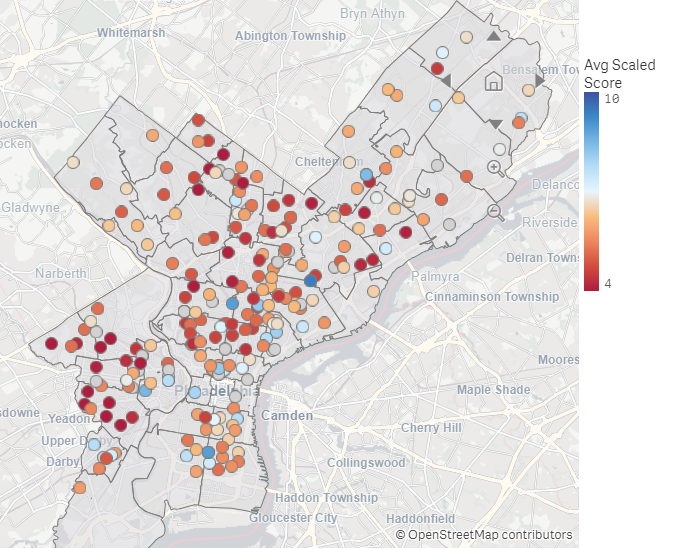
Building Condition subtopic scores by school
Bluer circles indicate higher scores, and redder circles indicate lower scores; District and alternative schools, 2023-24
Last modified: February 27, 2026