
By ChauWing Lam, Board Member
There is a difference between knowing what is happening in our schools and understanding what it feels like to be a student or an educator in one.
As a Board member, I spend considerable time reviewing data, discussing policy and making decisions that affect school communities across Philadelphia. Those responsibilities are essential: they influence how much and how we spend, determine the priorities our school and system leaders orient our energy and resources towards, and communicate the vision and expectations we have for our students.
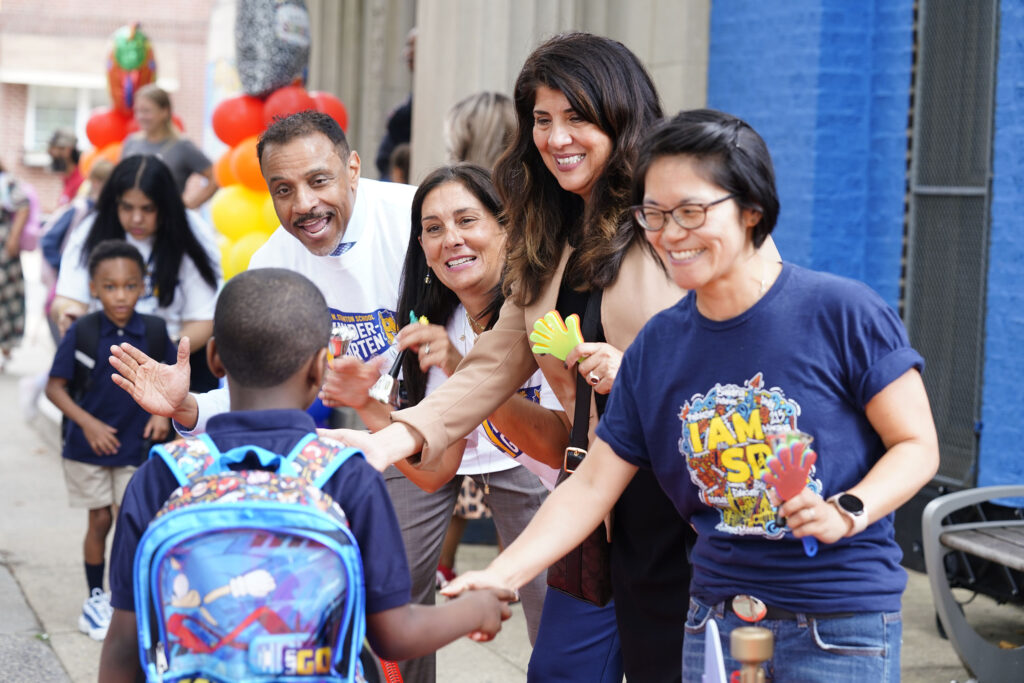
But some of the most important lessons come when I step away from the Constance E. Clayton Education Center, the School District’s central offices, and into our schools—when I see firsthand what students, teachers, and school-based staff experience every day.
I see the curriculum come alive as teachers translate standards into skills and practical examples. I listen to students tell me what they are learning and what they like and dislike about school. I witness the controlled chaos when the bell rings to signal class transitions, and the care taken in curating the student work displayed outside classrooms.
That is why school visits matter.
Students have something important to tell us.
When we take the time to listen, students often offer perspectives that cannot be captured in a report or dashboard. They tell us what they value about their school, what helps them learn, where they feel supported and where they see room for improvement. They remind us that education is not simply about programs, policies or performance measures. It is about their daily experiences and their hopes for what comes next.
Listening to students also means taking their concerns seriously—even when what they tell us is difficult to hear.
Teachers offer another essential perspective.
Teachers see the difference between policy and practice every day. They know what it takes to translate an initiative into a classroom, what supports students need to succeed and where good intentions can encounter real-world barriers.
During school visits, educators can tell us what is working, where they are finding creative solutions and what they need from the larger system. Their insights can help us ask better questions about the policies and priorities we set as a Board and importantly, reach better decisions.
And sometimes, listening means confronting a gap between what we intend and what students and educators actually experience.
That is an important part of accountability.
Not a substitute for data
School visits are not a substitute for data, formal oversight or the Board’s established governance responsibilities. One visit cannot tell us everything about a school or our system, and one conversation cannot define an entire school community. But firsthand experiences add context that helps us better understand the information before us.
Are our policies achieving what we intended? Are resources reaching students in ways that make a difference? Are there barriers we need to understand better? And when concerns are identified, are we following through?
For me, accountability means more than showing up for a meeting and casting a vote. It means being willing to see how decisions we make are experienced in classrooms. It means listening to the people closest to the work and bringing those perspectives back to the Board’s discussions.
Repetition is necessary
A single school visit is only a snapshot. But repeated visits—to different schools, classrooms and communities—can help us see patterns, understand differences and develop a fuller picture of the District we govern.
Most importantly, they keep us connected to the reason for the work.
Our students and educators have important things to tell us. As Board members, we owe it to them to show up, listen honestly and take what we learn seriously.
Because good governance doesn’t begin with having all the answers. But we reach better answers when we take moments to see, listen and reflect on where the work truly lies: in our schools.
Lam is a member of the Philadelphia Board of Education.